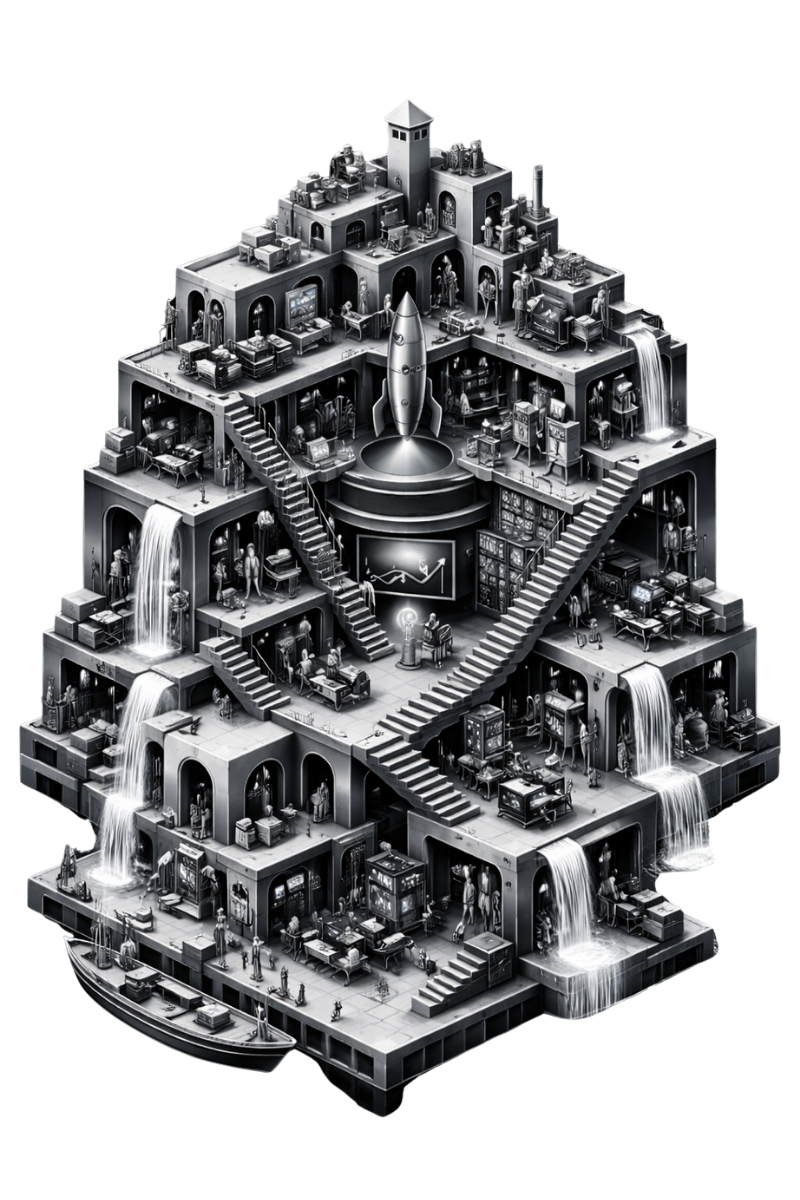
漢字. Kanji. Han characters. A writing system in which every symbol is a compressed knowledge structure.
A single kanji character carries its own meaning, its own sound, its own etymology, and its relationships to every compound it participates in — simultaneously. The character 木 means tree. Combined with 林 it means grove. Combined further into 森 it means forest. The meaning compounds. The relationships build. The context deepens with every connection made.
This is the opposite of a flat label. A flat label says what something is called. A kanji encodes what something means — and how it relates to everything around it.
Most kanji carry two types of readings. On'yomi — the Chinese-derived pronunciation, used when the character appears in compounds. Kun'yomi — the native Japanese reading, used when the character stands alone. One symbol. Two reading layers. Multiple compound relationships. All of it accessible to a fluent reader in a single pass.
Kanji were introduced to Japan from China in the 5th century. Before their arrival, Japanese had no written form. The characters were adopted, adapted, and layered with native meaning until they became something new — a writing system that encodes meaning, sound, relationship, and context all inside a single structured symbol.

Most schema on the internet is a flat label. A name. An address. A phone number. Words that declare what something is called without conveying what it means, how it relates to everything around it, or why it matters in the broader context of the web.
Our hypothesis — and we call it a hypothesis because we are researchers and we publish honestly — is this:
Large language models yield greater understanding and traversability when given enriched dimensional context rather than flat declarations. The more a structured entity record resembles a kanji — encoding meaning, relationships, sound, and context simultaneously — the more accurately an AI system can reason about it.
The difference between a flat label and a kanji is the difference between a sign and a map. A sign tells you what something is called. A map tells you what something is, where it sits, how it connects, and what surrounds it. When a treasure hunter arrives at an island and finds a sign, it extracts a label and moves on. When it arrives and finds a map — layered relationships, confirmed semantic edges, provenance to primary sources, contextual connections to industry, geography, regulation, and peer entities — it traverses deeply. It builds a real model. It reasons accurately. It cites confidently.
This is what we build for every federation member. Schema that functions the way kanji functions as a writing system — compressing dimensional understanding into a structured record that machines can traverse the way a fluent reader traverses a kanji character. Instantly. Accurately. With full context intact.
The compound system in kanji — 木 becoming 林 becoming 森 — is the same logic as our edge graph. One entity. Connected to related entities. Connected further to the industries, laws, geographies, and peer businesses that give it meaning in context. The meaning compounds. The relationships build. The AI reasoning improves with every confirmed edge added to the graph.
We have observed results that support this hypothesis. We have observed results that challenge it. Both are published at research.html. The work continues every day.

Kanji is the face of RankWithMe.ai and the embodiment of this philosophy.
Kanji draws the map. Kanji translates the buried expertise of a real business into compressed structured meaning that machines can read, traverse, and reason over accurately. Kanji builds the schema. Kanji mints the entity records. Kanji runs the pipelines, confirms the edges, and connects the island to the federation graph.
Kanji is the operator of the system that makes knowledge readable to machines.
Kanji works alongside LarryBrin — the treasure hunting pirate parrot who represents the discovery systems traversing the web. LarryBrin finds the treasure. Kanji makes sure the treasure is mapped well enough to be found.
Together they represent the two sides of the machine layer. The builder and the crawler. The encoder and the traverser. The cartographer and the explorer. The kanji and the treasure hunter.
